
Choosing the Best Cooling: Liquid or Air?
Technological advancements such as AI and cloud services are challenging the capabilities of traditional air cooling systems to maintain optimal temperatures in high-density rack environments. According to Vertiv’s Data Center Trends 2025 report, average rack densities are anticipated to soar to 500-1000kW in AI-driven facilities. As such, innovative cooling solutions are crucial to prevent equipment from overheating and causing costly, unplanned downtime.
Understanding How Liquid and Air Cooling Operate
Maintaining a reliable data center hinges on effective cooling strategies. Each piece of equipment generates heat that must be dissipated to avoid system failures. Air and liquid cooling systems both address this, but through distinct methods. Air cooling uses air to absorb and expel heat, suitable for environments with lower density racks. Precision cooling systems, like the Liebert PDX Compact DX Cooling System and Liebert ® CW Chilled Water System, offer versatile solutions for various facility needs.
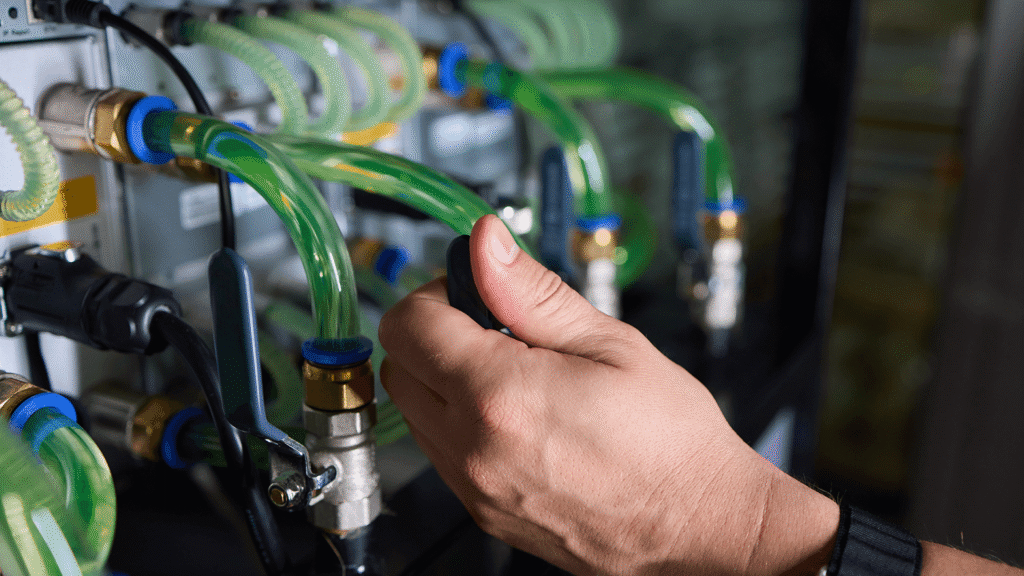
In contrast, liquid cooling utilizes water or specialized nonconductive liquids to absorb heat from equipment. The process involves circulating the liquid to absorb heat, subsequently cooling it, and reusing it continuously. Liquid cooling can be executed through:
- Direct-to-chip cooling: Sends coolant directly to server chips, such as the Vertiv™ CoolChip CDU.
- Rear door heat exchangers: Mounted on server racks to eliminate heat, like the Liebert® DCD Water-Cooled Passive Rack Door.
- Immersion cooling: Immerses the entire server in a nonconductive liquid to dissipate heat.
These methods provide a more direct approach than air cooling, accommodating higher density environments.
Deciding on the Right Cooling System for Your Data Center
Your choice of cooling solution should align with your facility’s rack density. For lower density racks using less than 20kW, air cooling systems are typically adequate due to their lower heat output. Consider solutions such as the Liebert DS Direct Expansion Cooling System to efficiently replace hot air.
However, high-density racks exceeding 20kW will benefit from liquid cooling systems. At levels of 30kW or more, liquid cooling becomes a necessity as traditional air cooling struggles to manage the excess heat. Employing a hybrid cooling strategy, which integrates both liquid and air cooling, may offer the most effective solution for managing high density environments.
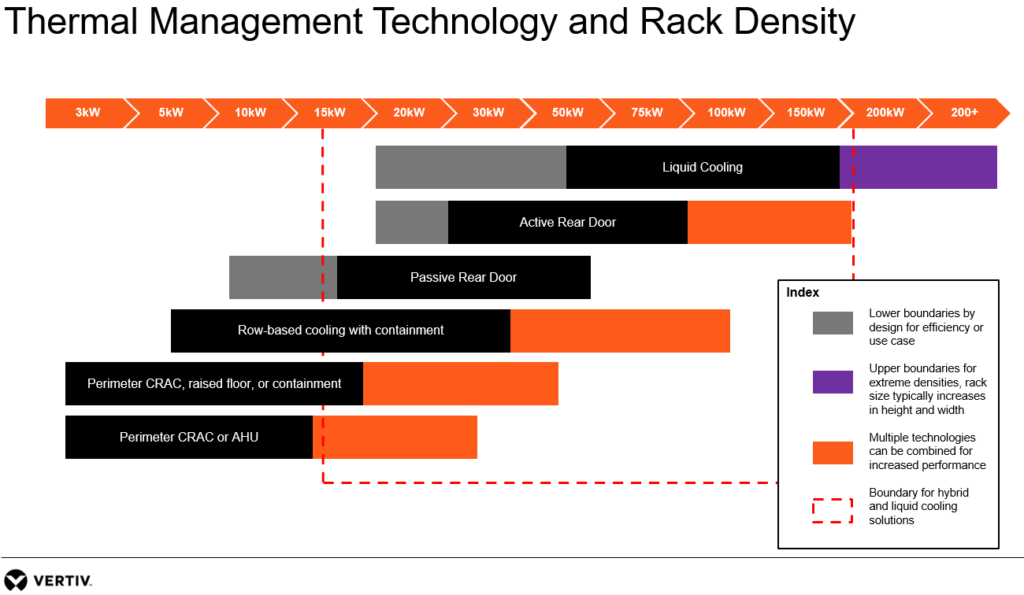
As AI technology encourages the use of high-density servers, combining cooling methods becomes more prevalent to maintain efficiency and lower costs. Products like the Vertiv™ CoolChip CDU are designed for such hybrid models, using liquid to cool chips directly while air conditioning manages the ambient room temperature. This ensures optimal conditions are met with reduced energy consumption.
Explore Further: Optimize Your Facility’s Cooling
Creating an ideal operational environment demands more than just managing rack densities, temperature, and humidity. Ensuring your devices function efficiently involves staying organized, secure, and current with the latest cooling technologies. To get tailored advice and updates, subscribe to our newsletter. For further assistance, contact us at 770.449.4010.
FAQs About Liquid Cooling
1. What is liquid cooling?
Liquid cooling involves using water or special liquids to transfer heat away from equipment, making it effective for high-density environments.
2. Why choose liquid cooling over air cooling?
Liquid cooling is more efficient for high-density racks as it can manage more heat than air cooling.
3. What are the types of liquid cooling?
The main types include direct-to-chip cooling, rear door heat exchangers, and immersion cooling.
4. When should a hybrid cooling system be used?
A hybrid system is ideal when dealing with high-density racks that require both air and liquid cooling methods.
5. How does liquid cooling save energy?
Liquid cooling systems often use pumps rather than compressors, reducing overall energy consumption.