
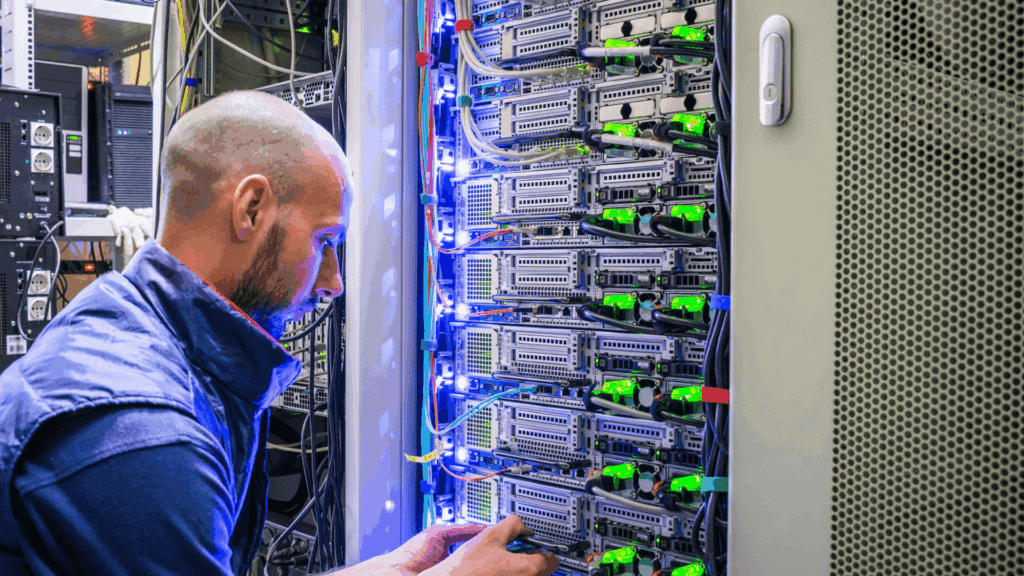
Maximize Efficiency: Server Rack Setup Strategies for Success
Don’t let unoptimized server rack systems disrupt your operations and lead to unexpected downtime. Gain insights on integrating server racks and power equipment seamlessly. Begin with a strategic server rack power arrangement to avoid unnecessary expenses and inefficiencies across one or multiple racks. Follow these expert guidelines:
- Assess and Understand Power Requirements
- Select Appropriate and Compatible Equipment
- Architect a Dependable Power Distribution Path
- Implement Comprehensive Monitoring Solutions
In this discussion, we’ll elaborate on each step and provide a detailed guide to help you choose the ideal PDU for your facility. Contact us at Joe Powell & Associates for personalized advice at 770.449.4010.
Evaluating Power Requirements
Understanding the power needs of your server rack equipment is crucial for crafting an effective power plan. An incorrect setup can result in reduced efficiency and wasted investments. Here’s how to determine your power needs:
- Review the manuals or labels on each device to find amperage/voltage, then calculate the total load.
- Add an extra 20% to the total load to accommodate future growth.
- Define redundancy objectives to decide between single or dual power feeds.
- Identify the available voltage and phase for your rack setup.
Ensure the chosen rack PDU also aligns with your rack’s spatial and logistical requirements. Consider the following:
- Matching receptacles and plugs with your equipment.
- Adequate internal space for all devices.
- Suitable mounting options.
- Advanced features like remote monitoring and environmental sensors.
These considerations enable you to choose server racks, rPDUs, and UPS systems that enhance, rather than hinder, your infrastructure.
Choosing the Right Equipment
To design a resilient server rack environment, you need more than just meeting power requirements. Reliable backup solutions and effective energy distribution are key. This is where uninterruptible power supplies (UPS) and PDUs become indispensable.
UPS Systems
UPS systems are critical for maintaining operations during power outages, bridging the gap until generators activate. Ensure your UPS has sufficient capacity and runtime for both current and potential future needs.
Rack PDUs
To meet specific power needs of each device, a reliable rack PDU is essential. These devices not only supply power but also manage and track energy use. Geist PDUs are versatile and customizable to fit any facility needs effectively.
Rackmount Automatic Transfer Switches
For seamless power continuity, especially in single-corded setups, a rackmount automatic transfer switch (ATS) is necessary. It switches between independent power sources, minimizing the risk of power disruptions.
Monitoring Equipment
Monitoring is crucial post-installation to prevent overloads. With proper tracking tools, you can understand power usage, ensuring your infrastructure operates within safe parameters.
Establishing a Robust Power Path
Integrate your UPS, PDUs, and server racks harmoniously for reliable facility power. Employ redundant power paths for safety, allowing maintenance without disrupting operations. Remember to balance loads between PDUs to guarantee adequate backup capacity.
Optimize physical organization with effective cable management to enhance airflow, especially with high-density installations. Vertical PDUs by Geist can facilitate this, improving outlet access and allowing for equipment expansion while monitoring environmental factors.
Server Rack Setup FAQs
What defines an efficient server rack power setup?
An efficient setup involves stable power delivery, balanced loads, and real-time monitoring. If frequent alerts or temperature issues occur, reevaluation is needed.
Why is load balancing critical in PDUs?
Load balancing prevents circuit overloads and enhances efficiency, supporting high-density systems. Intelligent tools simplify this process by providing real-time data.
How do environmental factors affect rack power efficiency?
Environmental conditions like heat and humidity impact power efficiency and hardware lifespan. Monitoring sensors help in promptly addressing these issues.
Which PDU orientation suits my needs?
Vertical PDUs are space-saving and enhance airflow, ideal for dense racks. Horizontal PDUs suit shallower deployments. Choose based on your spatial constraints and power requirements.
Can PDUs and UPS systems be monitored remotely?
Yes, integration with network management or DCIM systems allows remote monitoring of load data and alerts, aiding in swift decision-making.